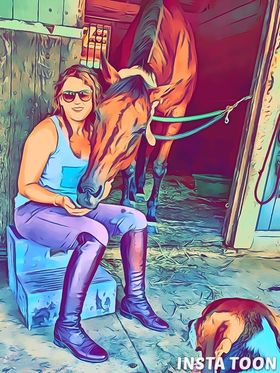
Finding Gideon:
A Broken Dream, a Missing Horse, and the Faith of a Mustard Seed
Chapters 1, 2, & 3

Chapter 1
Red disappeared, teleporting into another realm. There was no longer a horse underneath me; for half a breath I soared through the air, weightless. Brown dirt, Kentucky bluegrass, and morning sky blurred together like a toddler’s watercolor painting. Gravity snatched me from the air, hurtling me onto the racetrack.
Life moved in fractions of a second between gaping darkness and sheer, brilliant clarity. The first blackout must have happened in the time it took to squeeze my eyes closed as I hit the ground, because the thought after where is Red? was how am I on the track? The thought fluttered away in the chaos like an erratic butterfly as my head turned just enough to see what was coming.
Red tumbled toward me in a somersault. A 1000-pound horse was about to roll over me. This could be it, as in the “it” where my family lays roses on a casket decades before they should have to and I meet Jesus in person. If this isn’t “it,” I certainly might never walk again. I squeezed my eyes shut for a breath. Oh God. A prayer, not a curse. Everything, black.
My eyes opened with Red on the other side of me and the realization that I survived. That wasn’t so bad skimmed across my brain as my vision focused on a hoof surging toward my face. This could be bad. A blink. Darkness. A quick suck of air as the hoof of a panicking and flailing Red connected with my face, snapping my head back. Blank space. I heard nothing. It should have sounded like the solid hit of an axe on firewood. I felt no pain. I should have felt the agony like the flat side of a hammer smashing my face.
When my eyes opened and refocused, the light of early morning streamed in. Motion had stopped. Somehow I was cradled against Red’s belly like a foal against their mom, and I longed to press against him for the comfort we both needed. Unfortunately, a panicked horse is dangerous, and after the tumble we’d just taken Red would likely scramble to get back on his feet. I crawled away from the warmth of his belly on hands and knees before he could flail and cause more damage with those lethal hooves.
Red, a gigantic two-year-old racehorse and my second mount of the day, lay midway between the inside and outside rails of the dirt training track. The trainer had told me to gallop him two times around, but we hadn’t even made it to our first turn. Standing, spitting out blood and hard pieces of what must have been teeth, I turned toward the other side of the three-quarter-mile oval, where the trainer’s box stood like a sentinel. It was a raised, covered platform where trainers could watch their horses progress during morning gallops. Craig is there, and Robert. Surely they saw. Like a kid standing at my mommy’s feet, reaching up, begging for attention, for so many things I didn’t know how to express, my eyes lifted to the stand. Help.
Two weeks. Craig hired me two weeks ago to work for him and his Thoroughbred training and racing operation, promising to teach me to exercise the racehorses. It was my dream come true.
Robert, a friend from home, had come to the training track today to watch me ride. Did he see me fall? Am I the only person out here? I leaned over, bracing my hands against my knees, and spit another stream of blood and teeth. What should I do? The world spun.
Where are the other horses and riders who are normally on the track? Is Red okay? Am I okay? God? Am I okay? The sound of hoofbeats pulled my attention back down the track. I turned my head to see another rider galloping toward us, and air filled my lungs a little easier. I’m not alone. How is he getting his horse stopped so quickly? It’s not like the racehorses have good brakes. Eyes half-lidded, I watched the blood dribble from my face and land on the soft dirt, a pinkish color thanks to the saliva mixed in. The other rider flung himself off his mount and I recognized him—one of the few people here who had introduced himself to me. He was timid. Is his name Ryan or Bryan?
I stood and the world became more blurred watercolors. I knew this feeling. It was like in sixth grade when a horse lunged across his stall door, mouth gaping open like an alligator ready to attack. His teeth clamped down on my wrist before I could pull away, sending me into a vortex of shock and pain. I remember thinking why am I dizzy? just before I woke up amid moldy pieces of grain, mouse excrement, and spiders, with my riding teacher, Ms. Brenda, leaning over me with a rare look of concern.
I braced my hands on my knees again. If I pass out now, will I choke on blood? Will I die? I turned to Red to see him still lying down, but his head was up and alert. Ryan (or was it Bryan?) started toward me. Reins to a skinny, wary-eyed chestnut in his hand, his eyes flitted from Red to me in indecision. I like him, I thought. He cares as much about the horse as he does me, as any good horseman should. “Go to the horse,” I mumbled, stumbling toward a soft-looking patch of dirt.
“Are you sure?” His eyebrows nearly touched his hairline on his leathery, crinkled skin, a common reward for a career with horses.
“Yeah, I’ve got to lie down before I pass out.” I stretched out on my back, the lumpy safety vest hugging my torso and my helmet cradling my head like a pillow. Turning my head as far left as possible, I hoped if blackness overtook me, the blood would pour out of my mouth and not down into my lungs.
Oh God. Help.
“It looks like the horse’s foot is stuck on the martingale,” Ryan/Bryan yelled. I thought of the martingale, the piece of leather that stretched from between the horse’s legs to his reins, and my stomach clenched with guilt. It had been too long. All these racehorses wore martingales much longer than Ms. Brenda had taught, but when I asked the groom about it he said it was good.
“Okay. Can you…” I paused to breathe and spit. Before I got the rest of my words out, Red was up. I wanted to rub his forehead under his forelock, like I did for my own horse when he was upset. I wanted to tell Red it would be okay. They lingered; one man and two confused young horses. How long does it really take to get from the trainers’ stand to the far side of the track?
“Here comes Craig,” Ryan/Bryan said. From the lift of his chin, it was clear I still had a few minutes to wait so I didn’t turn to look. In the stillness, a thought popped into my head: what if Mom and Dad make me go home? I squeezed my eyes closed as reality sank in.
I don’t want to go home. God, I just got here. I just got here. Please don’t let my parents make me come home. And take care of Red. Help me, God. I don’t want to go home.
Home. Where I had once laid on the floor of my parent’s kitchen, kind of like I’m lying on the track now. I was holding it together now during this moment of physical trauma, but eight years before, I’d crumbled. Snot and tears smothered my face over simple words. Dinner that night had been a long-awaited moment.
For my entire twelve years of life, I had dreamed of having a horse of my own. I was a horse-obsessed girl. Every Christmas list to Santa or birthday list to parents mentioned a horse. When I saw a shooting star, 11:11 on the clock, or I squeezed my eyes shut to blow out candles, the wish was the same: a horse. Every day I pleaded with God to make this dream come true while sitting in a suburban Mississippi middle-class home. My dad was a CPA, my mom a teacher—neither knew nor cared anything about horses. We had neighbors every quarter acre who might have a pool, but certainly no backyard barns or fenced pastures.
On Saturday mornings, I woke before my older brothers, grabbed a blue windbreaker, and escaped to our tree seat. A treehouse would have been great, but we only had towering pines and two little cedar trees with paper-shred bark and sticky sap. My brother Joel did his best with what we had and wedged a piece of plywood between the branches on one cedar. He created a ladder by nailing wood scraps to the trunk and attached an old Easter basket to a rope so we could pull items up.
I read until the hot Mississippi sun evaporated the morning dew and my stomach demanded breakfast. Adventures on paper became my reality as I escaped a charging bull on a trail ride with my best friends, adopted a foal on Chincoteague Island at pony penning day, galloped down the final stretch at Churchill Downs to win the Kentucky Derby, and valiantly saved the beloved lesson ponies from a treacherous flaming barn. My heart was heavy with longing, and I begged God to make it real.
Dad successfully postponed “that horse problem” for several years, assuming it was a phase I would outgrow. “I’ll get you a horse when you’re twelve,” he’d declared somewhere around my ninth birthday, when the whole family was worn out from my obsession.
I catapulted from bed on my twelfth birthday and pulled the slats of blinds apart for a clear view of the driveway. There was no horse tied to the mailbox. Throughout the school day, I stared at the door, waiting for mom to pull me out of class and deliver me to the lesson barn where a horse with a big red bow waited. School ended, and I rode the bus home as usual. I sat on the couch and restlessly watched cartoons, realizing my schoolteacher mom would obviously never pull me from class. She’ll deliver me to the barn as soon as she gets home from work, I assured myself. But when she got home, she raced around doing laundry, cleaning the kitchen, and all the normal things moms do. It was a day of waiting, expecting.
At dinner, we sat around a table at the restaurant I chose, a perk of being the birthday girl, and my parents handed me a card. There had been many failed opportunities to surprise me with a horse, but I held onto a twinge of hope as I slid my hand underneath the seal of the envelope, tearing the flap open. Maybe the note would say, “Surprise! You’re the proud owner of your very own horse!”
Before I could read it, a hundred-dollar bill slipped from the folded cardstock and fluttered to the table.
I pasted on the biggest smile I could, though it seemed the entire world could see it didn’t reach my eyes. The server was clearing the dirty dishes when I worked up the courage to say something. “I really appreciate the money, but, uh, I thought you said when I turned twelve I could get a horse. And I’m even taking lessons.”
Mom gave Dad a sideways glance, which I interpreted as you really screwed up when you made that promise. He paused, looking at her to be saved. She looked back at him, her lips sealed tight. After a gaping silence in which my heart tried to work its way out of my chest, he responded. “Well, Sarah, I’ll tell you what. When you get all A’s on your report card, we’ll get you a horse.” The cloud of disappointment lifted a tad and there was a slight upturn in the corners of my mouth. “Deal,” I smiled. I normally made mostly A’s with a B or two mixed in. It was time to buckle down.
A few months later, we sat at the kitchen table for dinner. It was a rare evening when Nathan wasn’t at football practice and Joel wasn’t at work. The entire family was present. I proudly stretched my arm across the table to hand my dad an orange envelope containing my newest report card. This was it! The moment I had waited my entire life for!
The envelope was sealed and I wasn’t sure of the results, but I had worked extra diligently this semester. And for the last few weeks, every time Mom picked me up from my riding lesson, Ms. Brenda would walk over to the car and tell her all about this horse named Misty, who was perfect for me. Mom would nod, neither confirming nor denying that Misty was in my future. But I knew, if my report card was perfect, she had to be.
Dad bent each side of the brass envelope clasp forward, lifted the flap, and slid a folded piece of paper out. He read each grade aloud, a report card routine that usually produced glares from my brothers. I was the annoying, goody-two-shoes baby sister. But tonight, there was somber silence around the table. He made it to the bottom of the list and I gulped a relieved breath—all A’s with glowing comments from my teachers! Tilting in my seat to hear Dad’s next words, I watched him lean forward, dropping his eyes to the table for a second. Dad must be preparing to speak! He must be readjusting because this is the moment he finally says, “Let’s get you a horse!”
He slowly reached into his back pocket and fished out his money clip, flicking a hundred-dollar bill on the table in front of me and congratulating me for a job well done. I mumbled a “thank you” as I studied the woodgrain of the table, tore the corner off the napkin, and processed. My family dispersed, leaving me alone, glued to the chair in a trance.
God, I’m sorry I’m being so selfish. I prayed, willing the tears to stay in my eyes. Horse girls were tough. Horse girls didn’t cry. How many kids would be upset over a hundred-dollar bill for good grades? But it was supposed to be a horse, God! It was supposed to be a horse! HE PROMISED ME A HORSE! My calm, collected, find-a-way-make-a-way self crumpled from the kitchen chair onto the fake wood floor to cry over Dad’s fake promise and my fake hope for a dream I apparently wouldn’t reach any time soon. I stretched across the floor, hair falling around my face, and rested my head on my forearms while my body lurched with dramatically loud hiccups.
This was surely the final refusal. I had done everything I knew to do, and there was still no horse. My tears were those of a relentlessly positive girl who had lost hope, like a volcano that sat happily dormant for a lifetime until it was forced to erupt. For a moment I wasn’t worried about my big brothers making fun of me, my determination to be a tough horse girl who didn’t cry, or my lifelong goal of trying to impress my parents to get a horse. There would be no horse. I was just erupting.
Nathan strolled in, twitching his head to flick his perfectly highlighted hair out of his eyes. He glared at me, wallowing in my puddle of sorrow, and with exasperation, demanded an explanation for my hysterics. I set my jaw and narrowed my eyes at him from the floor, trying to decipher why he was asking, weighing his intentions. I couldn’t find any malice, so I hiccupped my way through a tale of broken promises and heartache.
“Crying won’t fix it,” he deadpanned.
“What?” I whimpered. What is he talking about? Why won’t he just leave me alone?
“Crying won’t fix anything. You’ve got to get up and do something about it. Go into Mom and Dad’s room and talk to them about it.” Underneath the harsh tone, there was a slight inflection to his voice, and I wondered if possibly my mean older brother really cared.
“O ki *hiccup* kay,” I pushed out while trying to decide whether there was any truth to this wisdom. Hadn’t I done everything there was to do already? In the pause, we stared into each other’s matching blue eyes, and I realized he had a solid point.
I lay on the floor stewing until he stepped over my prone body and walked out of the house, slamming the door like an exclamation point. He didn’t need to actually witness me heed his advice. When I was sure he was gone, I slowly stood, threw up a prayer, and made my way down the hall to my parents’ bedroom with swollen eyes and an occasional shoulder lurch from a sharp inhale. I tapped my knuckles against their white door.
“Come in,” Mom said.
My parents gave each other knowing looks. I surveyed the jury who would decide my fate. Dad looked simultaneously irritated and nervous while Mom took it all in with her trademark resting (scary) teacher face, which gave nothing away. My chest lifted as I gathered myself enough to talk.
“I came to talk about my report card,” I said.
“Okay,” Mom responded with a nod to go ahead.
Shaking on the inhale, I spilled. “Dad said… and Ms. Brenda… and all A’s… and the hundred-dollar bill… and I really appreciate it, but it’s not a horse. I have money saved up. With the money from tonight, I can give you $600, and that means you just need $400, and her board is only $225 a month.”
“So, you have $600?” Mom asked.
“With the money from tonight, yes!” I declared with slightly more confidence, chin jutted.
“Okay. Go get your money while your dad and I talk about it.”
“Really?” A question and exclamation in one. I sounded breathy as I raced from the room with hope pounding in my chest.
I clenched years of birthday and report card money in my sweaty hand as I strode back into their bedroom. The muscles of my mouth twitched into a delicate grin, unsure if this was really happening.
Within minutes, Mom picked up the phone by their bed and punched in Ms. Brenda’s number. “Hey Brenda, it’s Janet,” she said. “Tell us about this horse you think would be perfect for Sarah.”
After a brief conversation, she hung up the phone. Dad looked overly serious, probably panicking over the money pit he’d just walked into. The corner of Mom’s mouth tilted into the barest hint of a grin as I counted my cash into her hand. I tried not to laugh, or twirl, or do anything less than what a mature horse owner would do. Because the next day when we got to the barn, Mom was handing over the money and we were signing a bill of sale to purchase my very first horse, Misty.
Chapter 2
“Sarah?! Oh God, Sarah, are you okay?” Craig’s face popped into my sky view as he leaned over me.
Everyone from the trainers’ box had made it to the far side of the track where I lay dazed. Craig, Robert, and a third guy squinted at me, trying to survey the damage. Stoically I allowed them—invaded, embarrassed, and helpless—I couldn’t do anything to push them away. My teeth were jagged shards next to gaping, gummy, bleeding spaces in my mouth. They pushed on swelling lips that oozed blood. When I was a kid, my dentist, Dr. Boteler, finished every appointment saying, “Sarah, you have such beautiful teeth!” My insides shriveled at the thought. I never believed him, convinced they were too big, like Chiclets.
A search party was underway for the shiny bits of bone that were unceremoniously ejected from my mouth. People milled about, scuffing their feet in the dirt that must have told its own tale of the fall. Someone called an ambulance. Robert hung close, my safety blanket, a piece of home. I met him back in Mississippi through a mutual friend who knew I wanted to ride racehorses in Kentucky. Robert took me under his wing like one of his own nearly grown kids and gave me my first gallop on his horse, Gigi.
We trailered her to a backcountry track in the middle of nowhere, Louisiana. I had pulled the stirrups up as short as they would go, like the jockeys I’d seen on TV. When the gray mare started galloping, I couldn’t find balance by hovering over her like the other rider on the track. I tried clinging to her mane, leaning forward, and sitting back, but none of it worked. Halfway through the gallop, I took my feet out of the stirrups and sat, legs dangling as if I were bareback. Her muscles expanded and contracted beneath my blue jeans. I was a tad embarrassed and overwhelmed, but grateful. I fell in love with the little gray mare.
Craig rubbed his hands along Red’s body, checking for obvious injuries, before asking Ryan/Bryan to deliver the horse to the barn. The trio walked away from the chaos, heads lowered.
Bored and curious riders trekked around the oval to see the holdup. They lined up and leaned over me one at a time, blocking the wide, blue sky I was laying under. They squinted to see the damage under the darkness of their shadows, then brought hands to their mouths and rushed off like they were fighting to hold breakfast in.
I wanted to shout and wave my arms. Hello. I’m a human here! Not a corpse on the side of the road. The other rider from Craig’s barn was part of the procession. She didn’t talk to me. I was a spectacle, a crunched car on the freeway. We had ridden together for two weeks. She was on a horse next to me the first time I truly galloped, hovering over the horse’s withers, hands pressed into his neck as the hoof beats created music that matched the melody of my heart.
I wanted to punch her in the nose to see if she would notice me then. Instead, I shifted my eyes to the side as if I were the problem and sank into a numb calm. Vacant. I imagined my spirit lifting from my body and looking at the scene from above, like in movies. Then it hit me… what if I was more hurt than I felt. Didn’t people sometimes have life-threatening injuries after an accident and not realize it? I’ll not imagine my death.
We waited for the ambulance. Occasionally Craig leaned over and assured me it would be okay. I nodded and tilted my head to the side to spit out more blood. Robert hovered over me but didn’t say much. Sweat streamed from his graying sideburns.
They’ll do surgery at the hospital and have me back to normal in a couple days. It’ll be okay. God, please don’t let Mom and Dad bring me home, I pleaded.
I thought about the summer school class at the University of Louisville I would probably miss this week. Who would take care of my dog Sandi who waited at my apartment? How would I break the news about the accident to my parents and boyfriend, Joey? Or would someone else have to?
I wished I were with Gideon. We had the relationship I’d always dreamed of when I imagined having a horse. It took four tries, three other horses I loved but outgrew. Misty had sounded like a match made in Heaven to twelve-year-old me. I mean, she shared the name of the hero in my favorite childhood book! But she repeatedly found ways to drop me until one day she threw me onto a slab of concrete. Ms. Brenda declared it was time to move on.
Henry was next. He was a handsome chestnut with a white star who loved having a girl of his own. When I stepped off the school bus at Herald Farms, I’d walk out to the pasture and do our whistle. It started low until I narrowed my lips and finished with an ear-piercing shrillness. He would lift his head, eyes wide, and trot across the great big pasture to see me. But I grew as a rider and wanted to be a competitive barrel racer.
On the way home from another disaster of a run, Ms. Brenda turned to me, her hot pink Wet ‘n Wild lipstick highlighting the downturn of her lips. “I know you love that horse, but if you want to be a great rider, it’s time to move on. When you’re learning to ride you outgrow horses. Your family can only afford to keep one horse, which is fine. It’s part of life. You need to choose between keeping Henry or becoming a better rider.” I loved that horse, but I dreamed of being good enough to ride all the horses.
So, Henry went to a new home and Dixies Sugarbars entered my life. Dixie was a beautiful bay roan quarter horse mare. She had a stunning coat of white and red hair covering her body, like someone had sprinkled her with salt and cayenne pepper. But her legs, mane, and tail were dusty black. She was awe-inspiring to look at and as hard-headed as they come. When she ate, she attacked her grain, then pinned her ears, circling the stall and threatening the walls, flies, or anything else that would even consider approaching her food.
In ninth grade, drawn by the allure of the jumper world, I left Ms. Brenda’s and moved Dixie to the local hunter/jumper farm, Winterview. My horse hated it. She was miserable and challenged everything I asked her to do. Simple things like cantering a circle became an argument. She careened around the arena like we were at the Indy 500, and when I demanded she slow down, she hopped around like an angry rabbit. Sometimes she planted her feet and refused requests as simple as backing up.
I called Ms. Brenda in tears. She had taught me everything I knew and I needed her advice. After talking me through my woes, she asked if I could farm sit for a week at the end of the month. “Hey, while you’re here, there’s a chestnut horse you should look at. He’d fit in real well over at the hunter/jumper barn. Looks just like the kind of horse they want. Someone abused him around the barrels and he’s so anxious he needs to change jobs.”
“Okay, I’ll come farm sit and check him out when I’m there.” I wasn’t eager to be rid of Dixie, but I’d give this horse a chance.
“We call him Easy,” Ms. Brenda followed up. “You know, there’s power in your words.” If I’d heard that once from Ms. Brenda, I’d heard it a thousand times. There’s power in your words.
The end of the month arrived, and it was a busy week with thirty horses to care for after school. There was hardly time to slow down around the chestnut, but one day I pulled my barrel saddle out and took a few minutes to try him. We walked and jogged around the sand arena. It was just the two of us at a barn that normally bustled with activity, and melancholy happiness settled over us. Sitting on a horse who seemed happy to have a rider, the frustrations over Dixie lightened. He would fit well at the jumper barn with his long legs and lean, muscular body. He was drool-worthy, with white stockings stretching from his hooves to his knees and a big white blaze covering the middle of his forehead down to the edge of his bottom lip. Riding hadn’t felt right in months, but this felt good. Change was in the air.
The next week, Ms. Patti, the trainer at Winterview Farm, hooked up her horse trailer and drove the fifteen miles to Herald Farms. Winterview was picturesque and well-maintained. Evenly-spaced trees lined the road to the barn and a paddock by the sign housed very well-fed, expensive jumping horses. At Herald Farms, the place where I spent years becoming a horsewoman, the edge of the property featured a house trailer. Four long, narrow, boggy paddocks held muddy horses teetering on dry mounds in the center of their fields. Their hair was matted from being rained on and air drying, and I silently cursed them for not hiding under the sheds.
Biting my tongue, I focused my eyes on my knees and my mind on the trade papers, not wanting to cause or draw any insult to this sad-looking farm. Just because I left didn’t mean I didn’t love it. I signed the trade papers while Ms. Patti unloaded Dixie, my heart heavy and slow as I handed her off to Ms. Brenda. I had prayed over this and it felt right—not easy, but right.
The chestnut horse with four stockinged legs, a white blaze, and a little white around the edge of his eyes stood on a mound of old hay. A ten-foot-wide ditch crossed the center of his paddock. It smelled like hot mud and horse poop as the sun shone on us. Little birds swooped and chirped in the sky above.
Halter on my shoulder, I surveyed the massive amount of slop and regretted how bogged my boots would soon be. Taking a reluctant breath, I stepped through the gate into the shallow mud on the edge of the paddock. As I lifted my foot to move into the deep muck, I heard a sucking sound from the other side of the ditch. I glanced up to see that the chestnut had abandoned his dry mound and was lurching toward me.
The mud sucked at his feet, making each step a monumental effort. When he got to the ditch, he dropped his head and blew a loud snort at the water, creating a spray of tiny droplets and little rings that expanded until they disappeared. He looked up at me and then back to the ditch. Shifting his weight from one leg to the other and looking at me nervously, he rocked back on his haunches and leaped across the expanse of water, into my life.
I never left the spot by the gate as he walked up and touched his forehead to my elbow. “Hey, Easy.” I slipped the halter over his head as my heart grew. I whispered into his ear while we walked to the trailer, “Welcome to my family! We’re going to have fun! And I think we should change your name. What do you think?” He bumped his forehead into my arm again and a smile stretched across my face.
A bond snapped into place. The next day, I wrote “Gideon” on his stall when I came to visit, and when he saw me, he rushed to the door to say hello. He blew a gentle wind into my face, and I returned it. We soaked up each other’s presence. I was his safe place, and he was my dream come true.
Chapter 3
“I found it!” Robert bent over, then thrust what must have been my tooth in the air. He was too far away to see, but Craig and the other guy rushed to him excitedly. Did it matter? It felt like a souvenir, a shark tooth found at the beach. The find boosted their morale and gave them something to focus on beyond the pitiful girl laying silent and broken on the track. Eventually they returned to pacing and complaining about how long the ambulance was taking. Craig came and went, checking on Red and the other horses in the barn, then coming back to check on me.
Will the ambulance ever get here? I wondered. The jagged points of broken and newly crooked teeth pushed against my lips. How did this happen? How are my real teeth as bad, or worse even, than freaking Bubba teeth? They poked into the swollen skin inside my mouth, where there was a gap of empty, bloody gums. Is it better to lose teeth or for them to be broken? I sighed. I’m messed up. Things aren’t right. My heart pounded faster until it pulsed in my ears and even my fingertips. I can’t escape this. This happened to me, my body, my face. And what if Mom and Dad force me to come home? Could I even blame them? I couldn’t. But I don’t want to go home. Riding racehorses in Kentucky is all I want to do. God, please don’t let them make me go home.
What if it was ending here? What if years of dreaming, scheming, and sacrifices were useless thanks to this one fluke accident? I wasn’t ready to go. I’d only been galloping for two weeks. I didn’t know what was next, but I knew I wasn’t ready to give up. Everything had been at my fingertips. My determination had paid off, and I was good at this. But I wasn’t sure if the choice was mine. I could control and ride out a lot of things, but a horse disappearing from underneath me wasn’t one of them.
Silent tears streamed down my face, creating salty streaks in the dirt and wetting the hair by my ears as I lay on the ground. I don’t want to go home, God! Please don’t make me go home.
The shift of energy drew the men back to me like a fish on a line, some natural inclination toward a damsel in distress. They leaned over and peered down, all their eyebrows in nearly-comical matching slants. I wanted to spit in their faces to make them turn away. I hated the way my tears perked them up and changed the tone of their collective voice. I hated that I needed them.
I turned my head to spit blood and let the moisture from my eyes become part of the track. So much for tough horse girls not crying.
The ambulance arrived. EMTs leaped from the truck and raced toward me, shooting questions at the men as if they had been there and knew what happened. As if I hadn’t. They set an orange board beside me and voices came from every direction about how to transfer me safely onto it. This is ridiculous, I thought. I’m only lying down so I don’t pass out. But they didn’t want to risk anything. What if something broke in my back and I can’t feel it? I realized. The horse did roll over me.
Anxiety crept up my body, an itchy flush making its way to my neck and face. What if adrenaline is masking something worse than busted teeth? They removed my safety vest and helmet and strapped me to the stiff orange board. They wrapped a brace that would fit a six-four linebacker around my neck. I considered asking for a kid’s size, but not fitting into something so basic to humanity added to my humiliation. Could this neck brace separate my head from my body? My brother’s football career flashed in my mind. If I had expected anyone in the family to be carted to an ambulance in a neck brace, he was it. Though, I was glad it wasn’t him.
The EMTs set everyone abuzz, a blur of urgent conversations I no longer cared about. Just get me to the hospital and get this over with. My southern hospitality and perpetual hopefulness slipped into the dirt underneath the orange board.
The talking heads discussed which hospital to take me to. Honestly, y’all, aren’t all hospitals good? Get the show on the road. Craig demanded they not take me to the closest one because it was next to the prison. What’s the big deal? Are convicts just running around loose in the ER? I didn’t care where they took me as long as they got me there soon and did some kind of surgery to make this all go away so I could get back to dream-chasing.
They hefted me up into the ambulance and the double doors closed, blocking Robert and Craig’s pinched faces from view. It was just me, an EMT with beautiful dark brown hair, and a lot of machines. I had wondered what the inside of an ambulance looked like. It simultaneously met my expectations and shocked me. There was so much equipment jammed into this tiny space.
The EMT asked me questions, probably a method of distraction. Every time I moved my mouth to speak, the wrongness of it made me never want to open my mouth again. But she was also unexpectedly comforting. She didn’t wince or fret, yet I could feel her care. I was broken, but still human.
“Do you have any family around?” I could tell she assumed I did.
“No, I just moved here a couple weeks ago from Mississippi. Both my brothers and my parents still live there. I hope they don’t make me come home.”
“Why would they make you go home?” She seemed genuinely concerned.
“They didn’t really want me to come up here. But I’ve been wanting to ride on the track for forever. So I transferred up for my junior year of college.” My eyes drifted closed while I talked. I wanted to shut it all out. The beeps, clicks, and rattles of the gurney against the floor were sweeping me into a vortex. I was in the center as it spun out of control, and this EMT girl was keeping me grounded.
“So, what does that make you? Twenty-one?”
“I’m twenty,” I mumbled, remembering a book I read that had sparked this dream to gallop racehorses. I was probably eleven or twelve when I read it. The book had a jet-black Thoroughbred on the cover, a girl in jockey silks on his back. I had stared at the picture, getting lost in what-ifs, and my heart had clenched with want. The main character had an accident on the track and broke her back. She had a long and tumultuous but ultimately victorious comeback and, of course, won the big race on her favorite horse.
Regardless of the danger, the book planted a seed of desire to gallop racehorses on the track, and from then on nearly every horse-related book I read was about racing. They each watered the seed until it grew into a beautiful, gigantic tree with deep roots that was impossible to move, so I built my life around it. I knew in my gut I would end up in the hospital at some point while chasing this dream, just like the girl in the book. I just didn’t expect it to happen this soon.
But I also didn’t expect the journey here to take so long. The plan had been simple enough.
The summer after my junior year of high school, I contacted colleges, set up appointments to visit campuses, and with my mom’s help, booked flights. The anchor of our trip was a day at the races. While scouring a magazine called The Backstretch, I found a Saturday horse race that fit in perfectly with my college tours.
We flew into Louisville to start a large loop through the state. First stop, Churchill Downs. There were simply no words. For years I had watched the Kentucky Derby on TV, pored over articles about it in newspapers, and read books that took place on this track. It was the biggest fangirl moment of my life. The Twin Spires pointed toward Heaven and my heart lifted with them. This was my destiny.
We walked through the parking lot and I spent half a roll of film taking pictures of the track on the other side of the fence. Lacing my fingers through the wire, I pressed my head against the metal, straining for a closer look at the starting gates and dirt. I envisioned myself on a racehorse, breaking from the green mechanical padded doors. I snapped photos of the empty gates before Mom offered to take my picture in front of them.
We continued to the main entrance and Dad walked up to the ticket seller. “Hey, we’re here for the races,” he said.
The guy behind the glass leaned into his little microphone. “That’ll be eight dollars.”
“Eight dollars? That’s it? We’ve got two adults and one almost-adult. I think she qualifies as a kid still,” he said with a chuckle as he gestured to me. Mom and I had our eyebrows to our hairlines in shock.
“Yessiree! Three dollars for adults, two if you’re under eighteen on stakes day!” None of us knew what stakes day meant, but we smiled and nodded.
Dad counted out the bills to pay while I walked in slow circles. When I had my ticket I flew through the front entrance, greeted by a fenced-off area where horses were being led around an oval. Bright-colored saddle towels with numbers matched the smocks of the walkers. Some horses swaggered like they owned the place and others jigged around in a nervous trot. Immediately I decided the ones who strutted would win. I leaned against the fence, breathing in the smells of concession food mixed with horses. This must be what Heaven smells like, minus the hot dogs.
A bright bay horse with bulging neck muscles walked past me, making eye contact, and I gasped. Get over here! he said. You belong with us! His handler smiled at me and my stomach fluttered. I lifted my hand in a tentative wave.
Jockeys were tossed onto their mounts and disappeared through a tunnel under the stands. We raced in the same direction looking for seats. I didn’t want to miss a single second. I had imagined a crowd like I’d seen on TV for the Derby, but instead it was sporadic race fans, dressed casually, studying programs and holding squares of paper that must have had something to do with their bets. The horses danced around the track to warm up. I forgot to breathe as I watched the parade of glistening young Thoroughbreds, led by gussied-up lead horses, and all the horsemen on their backs. I longed to be one of them.
A bell rang and the field of racehorses exploded from the gates. A lump rose in my throat as my heart kicked up to match the frantic rhythm of hoofbeats that shook the ground. The track caller sped along, updating us stride by stride as the field moved to the far side of the track, nearly out of sight. I strained to see them, eventually settling for watching on the big screen, until a blur of movement appeared at the turn of the track. The field of horses stampeded toward us, coming down the home stretch. I leaned over the railing and snapped picture after picture. The air was electric as they made their final rally right in front of me, throwing clods of dirt in the air.
It was real, and I was here. I could stick my hand through the fence and touch a piece of the actual Churchill Downs track.
My dad struck up a conversation with a petite woman with dark brown curly hair who appeared to be in her mid-40s. Dad regaled her with the tale of my dream to ride racehorses and how we were in town to tour schools. Her eyes twinkled in excitement. “Would you like a tour of the racetrack?”
She introduced herself as Trish and whisked me away.
We went back to the small area at the front of the track where I first saw the horses being led around. Trish explained that it was called the “paddock.”
“But a paddock is where we turn horses out to graze,” I countered in confusion.
“True! But at the track, it’s what they call this area where the horses are walked around and saddled. They have some different lingo here.” Her eyes crinkled at the corners when she talked. “You’ll get used to it.”
“Okay!” I replied as I rushed to keep up with her.
“Want to go in?” Her devious grin said she already knew the answer.
Everyone in there appeared to be connected to a horse—trainers, grooms, jockeys. “Are we allowed?”
“They know me! It won’t be a problem!” She pulled an official-looking sticker from her pocket. “Put this on,” she said before she winked to the security guard and flashed a badge. He became the footman, opening the door to Cinderella’s magical carriage. I stepped down, one, two, three steps, and paused. I was no longer a peasant watching the ball from the outside. I was part of it, and I had to pause and take a breath.
“Come on!” My fairy godmother grinned at the awe emanating from my face.
I rushed across the dirt path between the horses and joined Trish on the grassy center of the oval. “Pretty cool, huh?” She bumped my arm.
My voice finally came to me. “This is incredible. Thank you so much!”

The horses circled—princes and princesses dancing around us. Someone in a green blazer broke the trance, yelling, “Riders up!” Jockeys were popped up onto horses’ backs before exiting the paddock and heading toward the track. It was time for the race.
The crowd that had pressed to the paddock fence disbursed in a rush toward the betting windows and the other side of the track. I started toward the gate we came through.
“Do you want to follow the jocks?” Trish’s question startled me. Surely the tunnel was forbidden to anyone on foot.
“Uh, are you sure?” I didn’t want to sound like a broken record, but…
“Yeah, it’s fine! Come on, we gotta hurry if you want to see the horses.” We jogged to the same opening the horses had exited through.
Trish knew everyone and they loved her. From the walkers who tossed their bibs into a laundry basket once their horses danced toward the track, to the outrider on a stocky mare who followed the herd, they chatted and laughed. A jockey walked alongside us and I tried not to stare. As he and Trish chatted, I decided maybe she wasn’t a fairy godmother. She was the unofficial mayor of Churchill Downs. People clamored to bask in the glow of her joy and kindness.
The horses in front of us reached the end of the tunnel, prancing onto the track in anticipation. While they warmed up, Trish walked me across the edge of the track, through the winner’s circle to an old-time analog scale. “This is where the jockeys weigh in with their saddles after the race.” She nodded a greeting to an older gentleman in a green blazer.
“You want to step on the scales?” the man asked.
A grin stretched across my face and I looked to Trish for confirmation. “Get up there!” she gestured toward the scale. “Give it a try! Here, give me your camera and I’ll take a picture!”
I stepped up. The numbers swirled beneath a needle and I turned to Trish and smiled, feeling completely cheesy but utterly thrilled.

The bell rang, and horses exploded from the gate. “Come on!” Trish dragged me away. “Let’s watch the race over here! Most people like to be up high, but the real horsemen watch the race by the rail, where the dirt can fly up and hit us.”
“Yes! I love being on the rail. You can feel the vibrations when the field runs by.”
“Here they come! Get your camera ready!” she shouted over the din of screaming fans. I leaned over the rail and snapped picture after picture as the horses approached and thundered past us. The crowd escalated until the horses passed the finish line. Little white squares of paper, previously gripped between the fingers of hopeful bettors, fluttered to the ground as heads tipped forward to study the racing program for the next race. Sporadic victors clutched winning tickets and raced to collect money.
Trish and I lingered around the winner’s circle to catch a close-up view. When the horse pranced back for a picture, they invited us to stand in the circle and be in the win photo. Is this even real?

Still wide-eyed, the tired horses marched away with their handlers to the other side of the track where warm stalls waited, and a buzz of anticipation filled the air. The headlining race of the day, the Stephen Foster with a purse of $831,000, was next. “Do you want some jockeys to sign your program?” Trish asked.
“Sure!” and we were off. We stood by the door to “the jocks’ room,” and when a jockey walked up, she handed him my program and asked if he could get some signatures.
“Sure, I’ll pass it around to the guys!” His eyes crinkled at the corners when he looked at me, and I was awestruck. I didn’t follow jockeys or know any of their names. But ten minutes later they cracked the door and passed my program back. Trish gave them a warm thank you and wished them luck while I gawked. Every jockey in the upcoming race had autographed my program.
Trish pointed out each signature, telling me about the winningest jockey of this year’s meet, who won the Derby, and more. I clutched my program to my chest, wanting to cry over this simple and beautiful thing. But we were moving too fast for emotions.
“I’ve got one more place to take you,” Trish shared. “You watch the Derby on TV, right?”
I followed her up the escalators as I told her about watching it at home and reading the write-ups in the local paper the next day. It was the only day Dad pulled the sports page for me. It was the only day I cared what the newspaper had to say. We went through doors marked for employees and soon stood in a room filled with wall-to-wall sound equipment, overlooking the entire Churchill Downs racetrack. Trish introduced me to one more friend, the guy who calls the races over the loudspeaker, including the Kentucky Derby.
They chatted while I marveled, searching my brain for questions and coming up empty. Really, I didn’t care about asking questions, I just wanted to be here.
We made our way to the rail, fangirled over our favorite horses, jumped and screamed, and took more pictures as they battled down the homestretch, and then it was done. The clock struck midnight. Time to go.
Trish delivered me to my parents and we showered her with gratitude for creating such a magical day, before making our way to the exit.
On our way out, Mom and Dad gratified me with a trip through the gift shop. While they waited to pay for our souvenirs, I slipped out of the air-conditioned building to stand in the sun. The bright rays warmed my pebbled skin and a heaviness settled in my chest. It went down my body, through my feet, into the ground of the legendary Churchill Downs. I didn’t leave a shoe on the front steps—I left a piece of myself, hoping I’d be back soon to reclaim it, but knowing deep down it might not be so easy.
